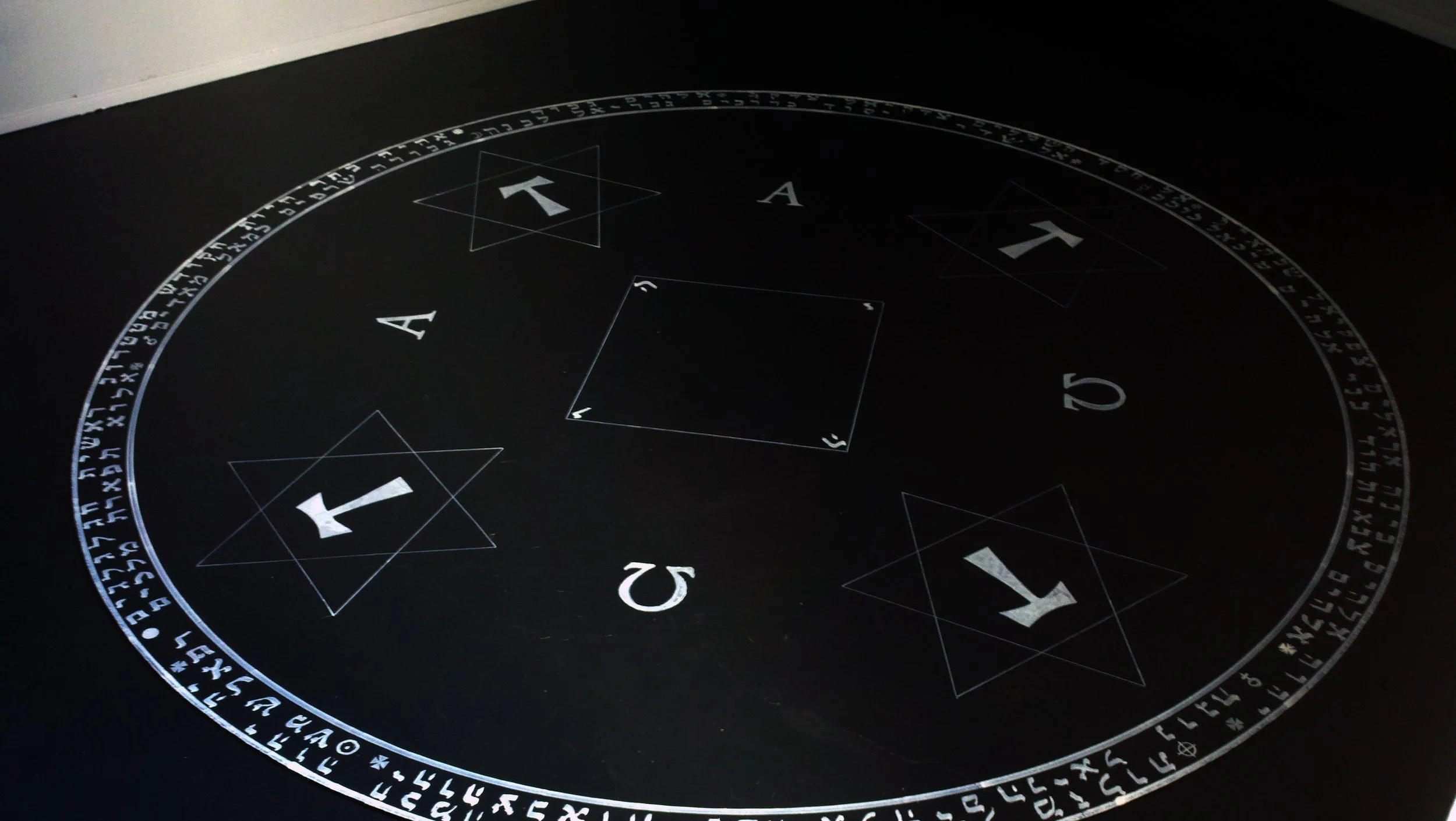
Few occult symbols evoke the sensation of a magical operation like the circle of the art. The circle defines the sacred space of the Magician. It is a veritable microcosm of the universe centered around the operator and functions as a divine fortress that protects those inside from all negative spiritual forces.
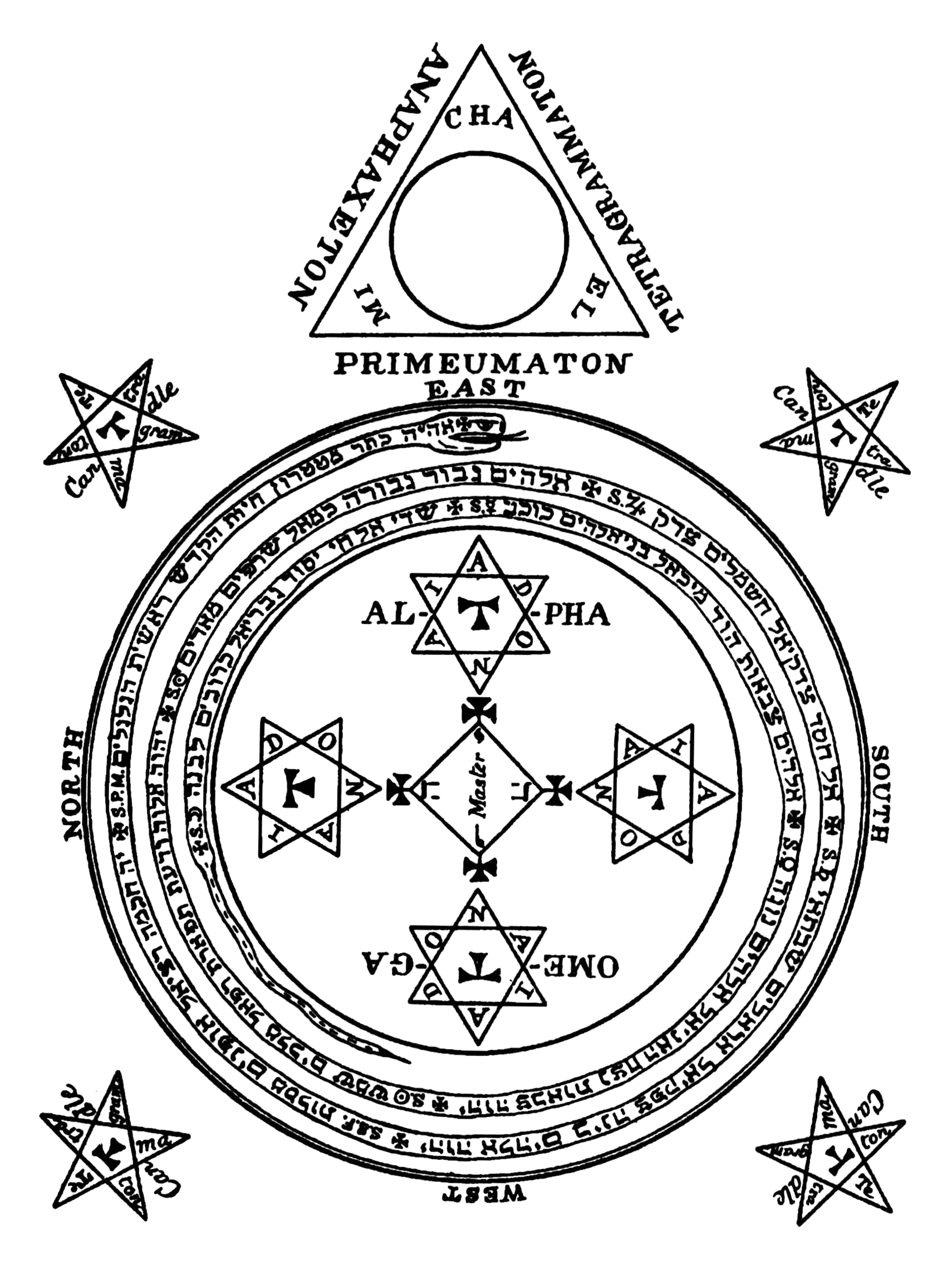
Of all the circles used in occult work, that of the Goetia or Lesser Key of Solomon is perhaps the most recognizable. Most quickly identify this circle with the version popularized by Mathers and Crowley containing bright colors and a serpent coiled around the circumference in which the divine names are written.[1] What few realize is that there are actually many surviving versions of the Goetia - all with slightly different representations of the circle and the divine names within. Furthermore, the serpent is only displayed in one private codex [2].
The text itself defines the circle in one line: "The circle of Salomon is to be made nine feet across, & the divine names are to be written around it, from Eheye to Levanah."
Eheye (אהיה) is Hebrew for "I am" and in traditional Kabbalah is the name of God assigned to Kether the first sefirot. Levanah (לבנה) is the Hebrew word for moon and is the planet traditionally assigned to the ninth sefirot, Yesod. All the manuscripts are in agreement that the practitioner is intended to write the divine names pertaining to the first nine sefirot around the circumference of the circle. These names can be found Agrippa's Scale of the number ten. However, the first appearance of these names along with the presiding angels, astronomical sphere, and order of angels occurs in the Sefer Yetzirah [3] which Agrippa likely used to populate his table. [4]
The tables below are provided for the reader to make their own decisions as to the names and their proper ordering. The first table compares three of the Sloane Manuscripts from the British museum alongside the names specified by Mathers and Crowley in their version of the Goetia. The major difference aside from the various spellings of the Hebrew names is the ordering within in each sefirot group. All three of the Sloane manuscripts correspond with Agrippa’s scale of ten where the order of the divine names is as follows : 1. God name, 2. name of the sefirot, 3. angelic order, 4. presiding angel, and 5. name of the astronomical sphere. The Mathers and Crowley edition alters this order by placing the presiding angel before the angelic order. Other differences such as the divine names used can be sorted out by using Agrippa's Scale of the number ten, or if one prefers the Sefer Yetzirah itself.
| Sloane MS 2731 | Sloane MS 3648 ** | Sloane MS 3825 | Mathers/Crowley | Key |
|---|---|---|---|---|
LKS Circle used by me from 2011 to 2013
| Key | Agrippa | Hebrew | Meaning |
|---|---|---|---|
Notes
Aleister Crowley (ed). The Goetia: The Lesser Key of Solomon the King.Trans Samuel Liddel, MacGregor Mathers. (Boston, MA: Red Wheel/Weiser LLC, 1995).
Joseph H. Peterson (ed). The Lesser Key of Solomon. (York Beach, ME: Weiser Books, 2001).
Aryeh Kaplan(tran.). Sefer Yetzirah (Boston, MA:Weiser Books, 1997).
Henry Cornelius Agrippa.Three Books Of Occult Philosophy. Trans. J. F. Edited by Donald Tyson (St. Paul, MN: Llewellyn, 1993).
More properly Chayoth Ha-Kadosh. See Sefer Yetzirah 1.2
In Sefer Yetzirah 6.6 this divine name is יה (Yah or Iah) as shortened form of YHVH. Compare to Mathers/Crowley edition.
Ha-Ophanim ( האפנימ) throughout Ezekiel is translated as "the wheels" (i.e. Ezekiel 1.16). In Sefer Yetzirah 1.2, Oauphanim ( ואופנימ) is identified as one of the higher ranks of angels composing the "wheels " of the throne of God. See Kaplan's edition and commentary.
See Isaiah 33.7
See Ezekiel 1.4; Chasmallim often translated as "electrum".
In Sefer Yetzirah 6.6 this divine names is Elohim not Elohim Gibor.
In Sefer Yetzirah 6.6. this divine name is solely the tetagrammaton YHVH. Compare to G:.D:. divine name for Tipheret "YHVH Eloah Ve Da'ath".
In Sefer Yetzirah 6.6 this is divine name is El Shadai ("God Almighty").
Originally published February 26, 2013 in Reflections from the Black Stone